.png)
Every July more than 130,000 people descend on the convention center and the surrounding twenty blocks to stand in line, celebrate new trailers, and be unapologetically obsessed with their favorite fandoms. It is the single largest gathering of fans on the planet, and for four days, the entire entertainment industry revolves around the events inside those halls.
Walk the floor at SDCC and you'll find Black cosplayers, Black artists in Artist Alley, Black executives running the parties the industry begs to get into, Black founders building publishing companies from the ground up, and Black-led panels drawing rooms so full people get turned away at the door. The culture is not adjacent to Comic-Con, it’s been incubating inside the con for years and is finally breaking through the mold and drawing the attention it deserves.
What's missing in these rooms throughout the SDCC weekend and beyond Comic-Con is the supporting level of investment.
There is another level of funding, sponsorship, and institutional support that could flow into these spaces, which are the same spaces brands spend all year trying to reverse-engineer from trend reports. The audience is already assembled, the creators are already building, and the infrastructure exists. What hasn't shown up at scale is the investment.
The Cosplayers
Cosplay at SDCC does not look like cosplay at DreamCon, BlerdCon, and Trap Sushi. The numbers aren't the same and nobody's pretending otherwise. But that gap is exactly what makes what Black cosplayers did in San Diego worth writing down.
There is a specific kind of nerve involved in spending six weeks and a rent payment on a build, then walking it into a room that has never been designed with you in mind. You are not blending in. You are the interpretation, as every character you touch becomes a statement about who gets to be that character, whether you asked for that job or not.
They did it anyway, at full volume, with better craftsmanship than the people questioning it. That's ownership and individuality at its most full potential.
Shaboozey Is Building a Comic Universe
One of the weekend's strongest activations didn't come from a gaming or entertainment studio. It came from a country artist with a comic book who is living proof that it is possible to transcend audiences and successfully step into other lanes and still be supported by your fans.
Shaboozey's signing was among the most talked-about activations on the floor. It represents something bigger than a celebrity side project: a Black artist with mainstream leverage choosing to invest that influence in the nerd world, focusing on original IP from the outset.
We covered the full story here: Shaboozey Is Building a Comic Universe and It Starts at Comic-Con.
And the independent lane is where most of this is actually happening. The Big Two get the Hall H slots; the books that are genuinely reshaping who gets to be a hero are being funded through Kickstarter, sold hand to hand in Artist Alley, and signed one reader at a time.
Black Girl Nerds Took Over the Pool Club
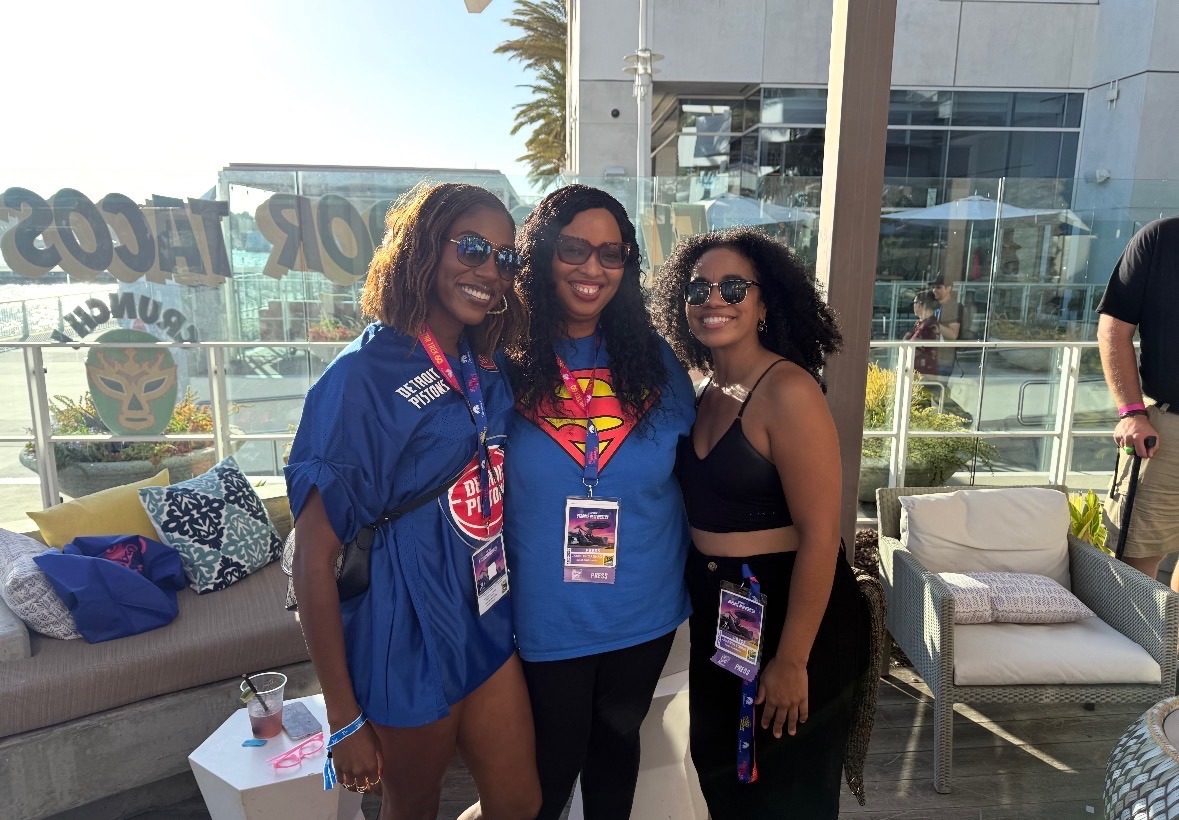
Founder and managing editor Jamie Broadnax has spent over a decade building Black Girl Nerds into one of the most durable institutions in this space, and the BGN meetup at SDCC is what that decade looks like in a room.
Held at The Pool Club at the Hilton Bayfront in partnership with the Nerd Initiative and the Electronic Frontier Foundation, the meetup is exactly what it says: a safe space to network, socialize, and geek out over your fandoms without translating yourself for anybody. Special guest Diarra Kilpatrick, star of Diarra From Detroit (streaming on Paramount+), joined the room.
It is worth noting what that partner list signifies. EFF is a digital rights organization and Nerd Initiative is a fandom platform; neither is a "Black brand." They collaborated because Broadnax built something worth showing up for, which is the central argument of this article: excellence demonstrated by one person without a nine-figure marketing budget.
Black Heroes Matter More Than Ever
The 2026 Black Heroes Matter panel brought together Ryan Benjamin, Denee Busby, Rob Edwards, Sanford Greene, Kadeem Hardison, Sebastian Jones, Jessica Murrey, and J. August Richards. This lineup spans comics art, screenwriting, animation, and on-camera work across four decades of Black pop culture. Sanford Greene's fingerprints are on Bitter Root and Spider-Verse. Rob Edwards wrote The Princess and the Frog and Treasure Planet. Kadeem Hardison and J. August Richards have been on our screens since before half the room was born. Sebastian A. Jones runs Stranger Comics, and the panel doubled as the SDCC premiere of the full teaser for the Niobe anime (a Black half-elven heroine, animated in South Africa by Mollo Animation, from a book Jones has been building since 2009).
"A hero is not the chosen one. A hero chooses to be one."
The movement itself started here, at this con, a decade ago. In 2016, comics writer David F. Walker organized a small Black Lives Matter flash mob on the SDCC floor. Baltimore artist URAEUS (Jacyen Wise) showed up with a couple dozen t-shirts he'd printed reading "Black Heroes Matter," intending to hand them to a few colleagues. He wore one for three days. The shirts became a phenomenon, the phenomenon became a panel, and the panel has run at cons across the country ever since.
Rooms like this are the load-bearing wall. A panel isn't a networking event; it's the only place where the people making this work are in the same square footage at the same time, in front of an audience that can see itself. Deals start there. Collaborations start there. Kids in the back row decide what they're going to do with their lives there.
Hilton George, Founder and CEO of Blerdcon, put it plainly:
"The maturity of the blerd community lay in its ability to manifest wherever black nerds exist. We are here at San Diego Comic-Con with multiple panels and events like Blerd&Boujee, and the con is better for it."
The Party
The IGN party is one of the hottest tickets of Comic-Con week: an industry-wide event that has nothing to do with Black programming and everything to do with power. It's run by Eugene Rivers II, who leads sponsorships and partnerships at IGN Entertainment.
That matters because it breaks the frame. Black influence at Comic-Con is not confined to the panels with "Black" in the title. It's in the rooms where budgets get moved, where brands get matched to properties, where the industry decides what it's excited about next year. We're not just the culture being covered. We're running the coverage, the events, and the sponsorship dollars behind them.
.png)